The Good Samaritan
- Mar 8
- 4 min read
Luke 10:25–37
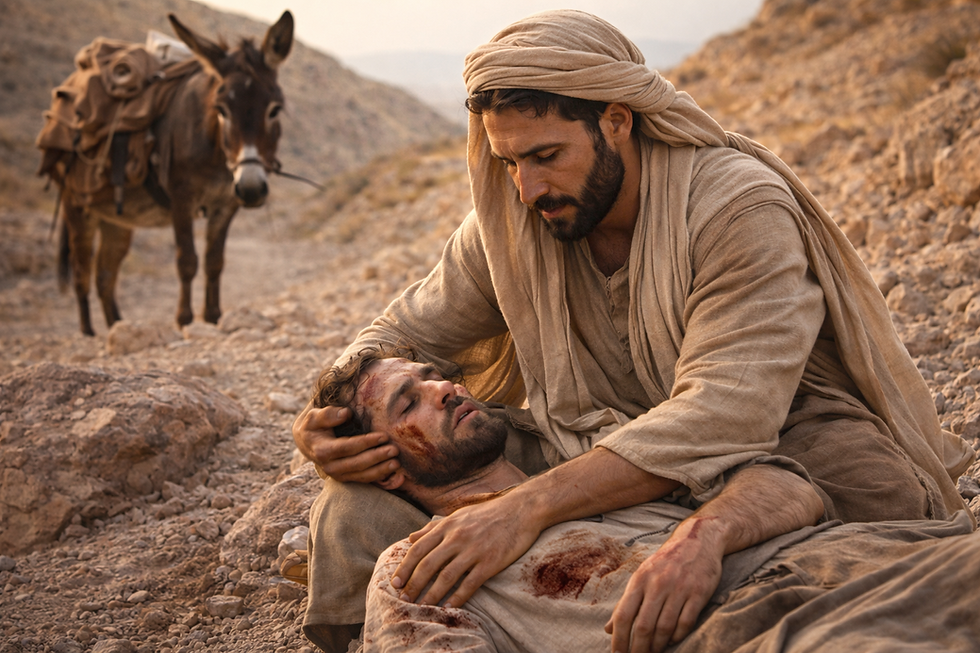
Some stories in Scripture are so familiar that we almost stop hearing them. The Good Samaritan is one of those stories. We know the outline: a man is beaten, left on the side of the road, and ignored by the very people who should have helped him. Then a Samaritan—someone unexpected, someone culturally despised—stops, sees him, and shows mercy.
But when Jesus tells this story, He isn’t offering a moral lesson about being nice. He’s answering a deeper question—one that still echoes in our own hearts: What does it really mean to love my neighbor?
The story begins with a lawyer asking Jesus how to inherit eternal life. Jesus turns the question back to him, and the man answers correctly: love God with everything you are, and love your neighbor as yourself. But then comes the question beneath the question: “And who is my neighbor?” In other words, Where can I draw the line? Who do I have to love, and who can I reasonably ignore?
Jesus responds with a story that removes the lines altogether.
A man is traveling from Jerusalem to Jericho—a notoriously dangerous road—when he’s attacked, robbed, and left half‑dead. A priest comes by, sees him, and passes on the other side. A Levite does the same. These are the religious insiders, the ones who know the Scriptures, the ones who lead worship, the ones who should embody compassion. But they keep their distance. Maybe they’re afraid. Maybe they’re busy. Maybe they’re unsure what to do. Whatever the reason, they walk past suffering.
And then comes the Samaritan.
To Jesus’ audience, this is the twist. Samaritans were outsiders, considered unclean, untrustworthy, theologically wrong. They were the last people anyone expected to be the hero of the story. But Jesus flips the script. The Samaritan sees the wounded man—and instead of crossing the road, he moves toward him.
He bandages his wounds.He lifts him onto his own animal.He brings him to an inn.He pays for his care.He promises to return.
This is not convenient compassion. It’s costly, time‑consuming, and deeply personal. It’s compassion that interrupts your plans and rearranges your day. It’s compassion that risks misunderstanding. It’s compassion that sees a human being before seeing a category.
And Jesus ends the story with a simple question: “Which of these three was a neighbor to the man who fell into the hands of robbers?” The lawyer can’t even bring himself to say “the Samaritan.” He simply says, “The one who showed mercy.”
Jesus replies, “Go and do likewise.”
This story isn’t just about helping people in crisis. It’s about the kind of person we’re becoming. It’s about the formation of a heart that sees, stops, and responds. A heart that refuses to let fear, prejudice, or inconvenience keep it from love. A heart shaped by the compassion of Jesus Himself.
And maybe that’s where this story meets us today.
Most of us won’t stumble upon someone bleeding on the side of the road. But we will encounter people who are hurting—emotionally, spiritually, relationally. People who feel unseen. People who are carrying burdens they don’t know how to name. People who are different from us, or difficult for us, or easy to overlook.
The question is not, “Who is my neighbor?”The question is, “Will I be a neighbor?”
Will I slow down enough to notice?Will I allow compassion to interrupt my schedule?Will I move toward someone instead of away?Will I let love cost me something?
Spiritual formation is not just about what we know—it’s about who we’re becoming. And Jesus uses this story to shape our hearts toward mercy. Not theoretical mercy. Not abstract kindness. Real, embodied, inconvenient mercy.
The Samaritan doesn’t ask if the man deserves help. He doesn’t ask what happened or who’s to blame. He doesn’t ask if someone else might be better suited to step in. He simply sees a need and responds with compassion.
This is the heart of Jesus.This is the heart He is forming in us.
And here’s the beautiful thing: we don’t do this alone. The same Jesus who tells this story is the One who stops for us on the side of the road. The One who binds our wounds. The One who carries us when we cannot walk. The One who pays the cost for our healing. The One who promises to return.
We love because He first loved us.We show mercy because we have received mercy.We become neighbors because Jesus became our neighbor.
If you let it, this story can become a gentle invitation to live with open eyes and open hands. To let compassion interrupt you. To let love stretch you. To let Jesus form in you the kind of heart that moves toward the wounded instead of passing by.
Reflective Question
Where is Jesus inviting you to “cross the road” toward someone in need—someone you might otherwise overlook, avoid, or pass by?
Breath Prayer
Inhale: Jesus, open my eyes.
Exhale: Make me a neighbor of mercy.
If this reflection opened something in your heart, you are welcome to share a comment below. The words of Jesus often deepen as we listen together.


Comments