When Authority Learns to Trust
- Mar 3
- 4 min read
Updated: Mar 9
The Healing of the Centurion’s Servant Luke 7:1–10
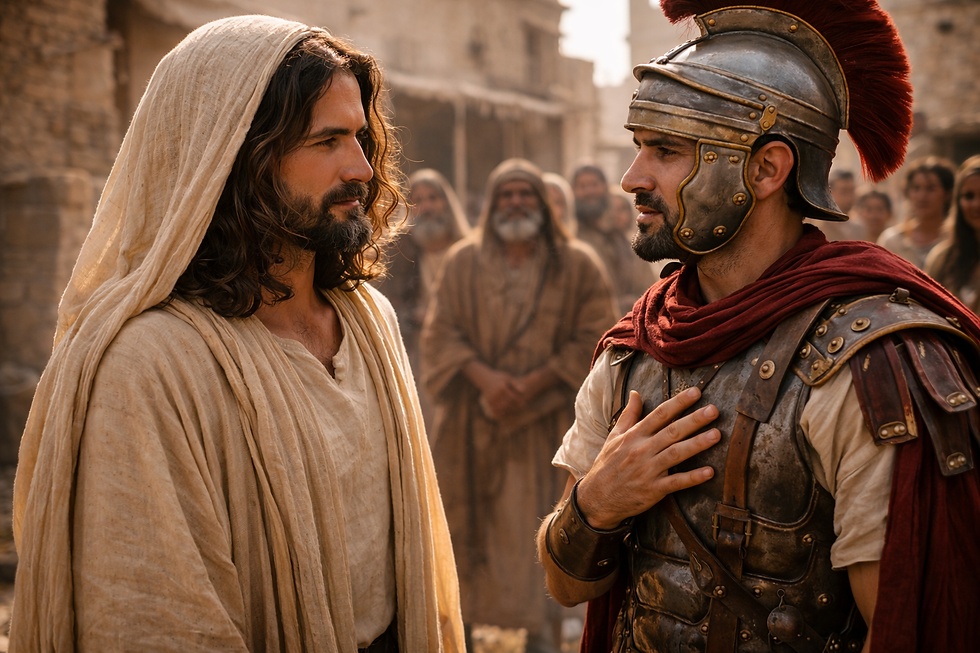
Some stories in the Gospels surprise us because of who shows up. Luke tells us about a Roman centurion—a man with rank, power, influence, and resources—who suddenly finds himself in a situation he cannot control. His servant, someone he deeply values, is sick and near death. And for all his authority, all his connections, all his experience, the centurion can’t fix this. He can’t command healing. He can’t order life to return. He can’t make things right by force of will.
It’s a moment many of us know more intimately than we’d like. Moments when our strength isn’t enough. Moments when our competence hits a wall. Moments when the things we usually rely on—our skills, our planning, our problem‑solving—can’t carry us. Moments when we realize that control is an illusion we’ve been holding onto a little too tightly.
And in that moment, the centurion turns to Jesus.
What’s striking is how he approaches Him. He doesn’t come demanding. He doesn’t come entitled. He doesn’t come assuming his status will get him special treatment. Instead, he sends Jewish elders to speak on his behalf—people who tell Jesus, “He is worthy… he loves our nation… he built our synagogue.” They’re trying to make a case for him, to justify why Jesus should help.
But when Jesus starts heading toward his house, the centurion sends another message—this time from his own heart: “Lord, I am not worthy for You to come under my roof. But just say the word, and my servant will be healed.”
It’s one of the most remarkable expressions of faith in the Gospels. A Roman officer—someone outside the covenant, outside the religious community, outside the expected circle of faith—recognizes something about Jesus that even many disciples struggle to grasp. He understands authority. He knows what it means to speak a word and see it carried out. And he believes Jesus carries a kind of authority that reaches beyond sickness, beyond distance, beyond human limitation.
“Just say the word.”
There’s no bargaining. No pleading. No attempt to control the outcome. Just trust.
And Jesus marvels. Luke says Jesus is amazed—one of the only times in the Gospels where Jesus is described this way. He turns to the crowd and says, “I tell you, not even in Israel have I found such faith.” And when the messengers return to the centurion’s home, the servant is healed.
It’s a beautiful story, but it’s also a deeply formational one. Because it invites us to consider what trust looks like in our own lives—especially in the places where we feel responsible, capable, or in control.
Most of us have areas where we feel like the centurion—where we’re used to being the one who handles things, solves problems, makes decisions, carries weight. We’re used to being competent. We’re used to being dependable. We’re used to being the one others look to. And those are good gifts. But sometimes those strengths can make it harder to trust Jesus. Harder to release control. Harder to admit that we can’t fix everything.
The centurion shows us a different way. He shows us that real faith isn’t about pretending we’re weak—it’s about recognizing where our strength ends and God’s begins. It’s about acknowledging that even our authority has limits. It’s about letting Jesus be Lord not just in theory, but in the places where we feel the most pressure to hold everything together.
And notice this: Jesus doesn’t shame the centurion for having authority. He doesn’t tell him to give it up. He honors his faith. He honors his humility. He honors his willingness to trust. The issue isn’t authority—it’s what we do with it. Do we cling to it as if everything depends on us? Or do we bring it to Jesus and say, “I can’t do this part. I need You to speak the word”?
Spiritual formation often involves learning to trust Jesus in the places where we’re most tempted to rely on ourselves. It means letting Him into the parts of our lives we try to manage alone. It means believing that His word carries power even when we can’t see how things will unfold. It means loosening our grip on outcomes and opening our hands to grace.
If you let it, this story can become a gentle invitation. Not to abandon responsibility, but to release the illusion that you have to carry everything. Not to stop caring, but to stop controlling. Not to give up, but to give over—to trust that Jesus can speak life where you cannot.
Sometimes the most courageous thing we can do is what the centurion did: admit our limits, ask for help, and trust that Jesus’ word is enough.
Reflective Question
Where in your life are you trying to hold everything together—and how might Jesus be inviting you to trust His authority instead of your own strength?
Breath Prayer
Inhale: Jesus, speak Your word.
Exhale: Teach me to trust You.
If this reflection opened something in your heart, you are welcome to share a comment below. The words of Jesus often deepen as we listen together.


Comments